How to Install a Drip-Irrigation System | Ask This Old House
ADVERTISMENT – become one of us and contribute knowledge
You Might Be Interested In
Comment (0)
LEAVE YOUR COMMENT
You must be logged in to post a comment.
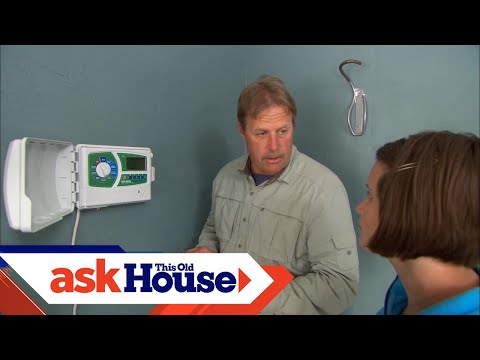
Landscape contractor Roger Cook helps a homeowner install a water-saving drip-irrigation system. (See below for a shopping list, tools, and steps.)
SUBSCRIBE to This Old House: http://bit.ly/SubscribeThisOldHouse
Shopping List for How to Install a Drip-Irrigation System:
– Drip-irrigation system, including tubing, fittings, connectors, and hardware
– 1 1/2-inch-diameter PVC pipe, to install under the sidewalk[BR][BR]
– Metal staples, to secure the tubing
Tools List for How to Install a Drip-Irrigation System:
– Flat-blade shovel, to scrape away gravel
– Small sledgehammer, to tap in the staples
– Utility knife, for cutting plastic tubing
– End nippers, to pinch closed crimp connectors
Steps for How to Install a Drip-Irrigation System:
1. Use flat-blade shovels to remove the gravel from the yard and form shallow trenches. Don’t cut through the black plastic below.
2. Excavate trenches from the existing main water line across the yard and around every shrub and tree.
3. Connect an electric solenoid valve to each zone of the main water line.
4. Attach a pipe with backflow preventer to each solenoid.
5. Add another length of pipe and then install a pressure-reducing valve.
6. Open the valve to flush out dirt and debris from the main water line.
7. If necessary, dig below the sidewalk and push a length of 1 1/2-inch-diameter PVC pipe underneath the sidewalk.
8. Feed the main feeder line from the valves through the PVC pipe and along the trenches.
9. Hold the tubing in place with metal staples spaced 24 inches apart. Use a small sledgehammer to tap in the long staples.[BR]
10. Use a utility knife to cut through the main feeder line.[BR]
11. Push a three-way barbed T-fitting into the cut end of the feeder line. Secure the line with a metal crimp clamp.[BR]
12. Attach the other end of the feeder line to the opposite side of the three-way fitting.[BR]
13. Onto the final barbed end of the three-way fitting, connect a feeder line that extends out to the nearest tree or shrub.
14. Trim the end of the feeder line to length, then push on a 90-degree elbow. Secure the elbow with a crimp clamp.
15. Onto the elbow connect a length of flexible drip-irrigation tubing.
16. Lay the tubing into the trench around each tree and shrub.
17. Secure the tubing with staples spaced 24 inches apart.
18. For larger trees, install two irrigation lines.
19. Run a feeder line alongside the sidewalk, then add drip-irrigation lines to water each nearby shrub.
20. Punch the emitter into the 1/2-inch-diameter feeder line, then attach one 1/4-inch-diameter drip-irrigation line for each shrub.[BR]
21. Install an electronic smart controller in the garage and program it for optimum water usage.
22. On the house roof, install a sensor that detects air temperature and rainfall. The sensor will determine when to turn the sprinkler system on and off.[
23. Backfill the trenches with gravel.
24. Blow out the sprinkler system with air, then turn on the water.
About Ask This Old House TV:
Homeowners have a virtual truckload of questions for us on smaller projects, and we’re ready to answer. Ask This Old House solves the steady stream of home improvement problems faced by our viewers—and we make house calls! Ask This Old House features some familiar faces from This Old House, including Kevin O’Connor, general contractor Tom Silva, plumbing and heating expert Richard Trethewey, and landscape contractor Roger Cook.
Follow This Old House and Ask This Old House:
Facebook: http://bit.ly/ThisOldHouseFB
Twitter: http://bit.ly/ThisOldHouseTwitter
http://bit.ly/AskTOHTwitter
Pinterest: http://bit.ly/ThisOldHousePinterest
Instagram: http://bit.ly/ThisOldHouseIG
http://bit.ly/AskTOHIG
Tumblr: http://bit.ly/ThisOldHouseTumblr
For more on This Old House and Ask This Old House, visit us at: http://bit.ly/ThisOldHouseWebsite
How to Install a Drip-Irrigation System | Ask This Old House
https://www.youtube.com/user/thisoldhouse/
You must be logged in to post a comment.
This site uses Akismet to reduce spam. Learn how your comment data is processed.
She looks good
What the hell? 3:40 his pre-installed PVC sleeves crossed beneath the sidewalk lol
What a fiasco
the firs scene with the needles turning brown is a crock of crap…. rule NO1….. if the needles are green on the ends and brown behind them, all is good, natural shedding. if the needles are brown on the ends,,, NOT GOOD
1:22 in the video,,,, never mix brown and black poly together, they are different diameters,,,, black is a little larger diameter than the brown. he has a brown connector, he should be suing a black connector.
After all of the hard work, they went to Los Pollos Hermanos to grab some chicken.
Who in their right mind would wanna live in new Mexico…
0:17 – 0:28 What a bogus rule. I am glad that does not exist in my region.
5:48
Good luck cleaning out those upside down filters.