

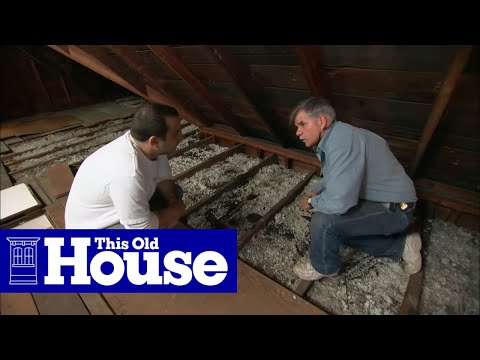
How to Beef Up Attic Insulation | This Old House

Cost-effective way to save energy with This Old House general contractor Tom Silva. (See below for a shopping list and tools.)
SUBSCRIBE to This Old House: http://bit.ly/SubscribeThisOldHouse
Tools for Beefing Up Attic Insulation:
– tape measure [https://amzn.to/2FswC14]
– insulation knife [https://amzn.to/2RptXK4]
– leaf rake [https://amzn.to/2Ni06Fl], used to spread cellulose insulation
– dust mask [https://amzn.to/2ISOmDq]
– hammer [https://amzn.to/2Fp3xU6]
– circular saw [https://amzn.to/2WRVh4Y]
Shopping List for Beefing Up Attic Insulation:
– cellulose insulation [https://amzn.to/2Fjt29p]
– un-faced fiberglass insulation [https://amzn.to/2Y2rMi8]
– 2x10s [https://amzn.to/2IUGvFC] for framing a storage platform
– 7/16-inch-thick OSB
– 16d nails [https://amzn.to/2IZcAMC] for nailing together 2x10s
– 6d nails [https://amzn.to/2RtGJHE] for nailing down the OSB
2-inch-thick polystyrene [https://amzn.to/2N61kmI], used to cover subfloor
About This Old House TV:
This Old House is the No. 1 multimedia home enthusiast brand, offering trusted information and expert advice through award-winning television, a highly regarded magazine, and an information-driven website. This Old House and Ask This Old House are produced by This Old House Ventures, LLC and are presented on PBS by WETA Washington, DC.
Follow This Old House and Ask This Old House:
Facebook: http://bit.ly/ThisOldHouseFB
Twitter: http://bit.ly/ThisOldHouseTwitter
http://bit.ly/AskTOHTwitter
Pinterest: http://bit.ly/ThisOldHousePinterest
Instagram: http://bit.ly/ThisOldHouseIG
http://bit.ly/AskTOHIG
Tumblr: http://bit.ly/ThisOldHouseTumblr
For more on This Old House and Ask This Old House, visit us at: http://bit.ly/ThisOldHouseWebsite
How to Beef Up Attic Insulation | This Old House
https://www.youtube.com/user/thisoldhouse/


About The Author

You Might Be Interested In


Comment (0)
LEAVE YOUR COMMENT
You must be logged in to post a comment.
Tony! You b. I tch
No mention of the most important consideration: air sealing. This seems like a huge missed opportunity to remove the existing insulation to air seal, which based on the age of this house there is now way it was done correctly.
What about air sealing before adding more insulation. With only two inches it wouldn't have even been difficult. Such a missed opportunity
This Old House is a great company. All bath vents and other vents need to go through the roof or wall to the outside. To use the insulation to maximize the energy efficiency of your home, installing the new Smart Roof Deck System directly above the roof deck above the rafters would totally seal this attic from all harms way. It still allows moisture to escape but insulation is recommended to be pushed into all soffits and ceilings to stop all air flow and birds, insects etc. Read more about it at: @t and thanks to This Old House, houses are getting sealed up and insulated properly!
This Old House is a great company. All bath vents and other vents need to go through the roof or wall to the outside. To use the insulation to maximize the energy efficiency of your home, installing the new Smart Roof Deck System directly above the roof deck above the rafters would totally seal this attic from all harms way. It still allows moisture to escape but insulation is recommended to be pushed into all soffits and ceilings to stop all air flow and birds, insects etc. Read more about it at: @t and thanks to This Old House, houses are getting sealed up and insulated properly!
Whats that pink insulation called?
This is a great example of a little knowledge being a dangerous thing; where it misleads those with less knowledge because the terminology used is inaccurate and inappropriate. The guy refers to the paper layer on some insulation quilts as a "vapour barrier". Whilst he goes on to correctly describe the outcome of installing a vapour barrier in the position shown, the paper is not and can never be a vapour barrier and in fact would do no harm in this instance. He then describes a gap in the insulation as an "air leak". This is not an air leak; this is a 'cold bridge'. The nature of the insulation being used is 'open cell' and as such promotes the movement of air through it as it is a 'breathable' material. As opposed to other types of insulation such as the blue extruded polystyrene shown at the end of the clip, which is 'closed cell' insulation. It also jumped out at me that there was no mention of checking there was adequate cross ventilation within the roof space, as with enhanced insulation must go great ventilation otherwise you will find a build-up of condensation on the underside of the roof covering materials. Insulating old buildings can be a minefield if you don't know what you are doing one hundred percent. Just remember that if you insulate you have to ventilate. If you don't you will end up with more problems than you started with. The knowledge key is how you do it.
I been watching videos that said you need to make sure attic/joints/joists/fixtures are sealed because air escapes and insulation isn't effective.
The best example someone has explained is a jacket with a zipper. If temps are zero your losing a ton of heat from your jacket fast. Will you notice at 40 degrees? Not nearly as much.
when I had to work in an attic as an electrician, there was no real walkway and you had to crawl through a double hatch. The ceiling was low so you had to crawl on your knees along the cross pieces.