

How to Build a Simple Dry Well | Ask This Old House

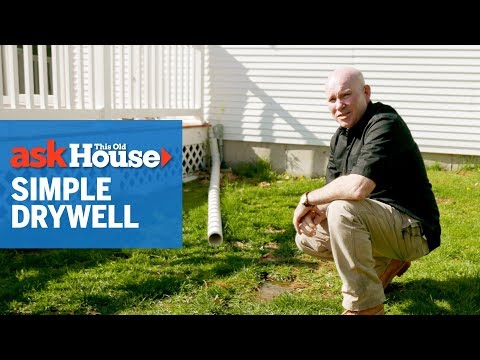
Ask This Old House mason Mark McCullough installs a dry well for a homeowner with drainage issues in his backyard
#ThisOldHouse #AskTOH
SUBSCRIBE to This Old House: http://bit.ly/SubscribeThisOldHouse
Time: 5-6 hours
Cost: $200
Skill Level: Moderate
Tools List for Building a Simple Dry Well: [YT]
Shovel [https://amzn.to/2nlsNoF]
Tarp [https://amzn.to/2p2pkM4]
Utility knife [https://amzn.to/2ok2jnh]
Wheelbarrow [https://amzn.to/2nlKrsn]
Hand tamper [https://amzn.to/2nva7mf]
Shopping List: [YT]
4 inch PVC pipe [https://amzn.to/2njvVRT]
4 inch PVC perforated pipe [https://amzn.to/2nxwqYn]
4 inch PVC couplings [https://amzn.to/2p2gfmu]
4 inch PVC elbow [https://amzn.to/2mDiiMQ]
PVC glue [https://amzn.to/2p2EMb2]
Landscape fabric [https://amzn.to/2nlXoCw]
Crushed stone [https://amzn.to/2nlI5tz]
Steps:
1. Before starting the project, call the local utility locating service and have them mark out any potential underground utilities that could get in the way of the dry well.
2. Lay out the PVC pipe and determine the location for the dry well. The solid pipe will go closest to the house, and the perforated pipe will go closest to the dry well.
3. Use the shovel to cut into the soil just underneath the grass and move the top layer to a tarp. That way, the grass can be put back in place once the trench is dug.
4. Next, dig a trench to accommodate the PVC pipe that’s roughly 8-10 inch deep. As the trench gets closer to the dry well, make the trench slightly deeper and slightly wider to ensure no water leeches back towards the house.
5. Now start digging the hole for the dry well. It should be about 4 foot in diameter and 3 foot deep.
6. Cover the bottom of the dry well with a few layers of landscape fabric until the hole is completely covered.
7. Use the remaining landscape fabric to line the trench. It only needs to go as far as the perforated pipe.
8. Pour the crushed stone into the hole one wheelbarrow-full at a time. Between each pour, tamp down the crushed stone with a hand tamper. Repeat this process until the hole is filled to the level of the trench.
9. Put a thin layer of crushed stone in the trench.
10. Connect the PVC pipes using the couplings and the PVC glue. Use the elbow to connect a vertical piece to catch the rainwater from the gutter. Once it dries, place the pipe in the trench.
11. Fill the rest of the trench and the hole with the remaining crushed stone, leaving just enough room at the top for the layer of grass.
12. Fold over the landscape fabric to cover the crushed stone.
13. Backfill the hole and the trench with the grass.
Resources:
Installing a simple dry well requires few tools and materials. Mark lined the trench with landscape fabric, which can be found at any home center. He then filled the trench and the hole with crushed stone, which can be found at masonry supply stores and some home centers. The pipe he installed was two sections of solid PVC pipe and one section of 4 inch perforated PVC pipe. The pipe and the PVC glue required to secure the connections, are found at home centers.
When installing a dry well in a small yard with little space for leeching, Mark also suggests installing a plastic basin [https://amzn.to/2p2KU32] in the hole to allow for more controlled drainage. The yard in the video was massive and slightly sloped downhill away from the house, so the plastic basin wasn’t necessary.
About Ask This Old House TV:
Homeowners have a virtual truckload of questions for us on smaller projects, and we’re ready to answer. Ask This Old House solves the steady stream of home improvement problems faced by our viewers—and we make house calls! Ask This Old House features some familiar faces from This Old House, including Kevin O’Connor, general contractor Tom Silva, plumbing and heating expert Richard Trethewey, and landscape contractor Roger Cook.
Follow This Old House and Ask This Old House:
Facebook: http://bit.ly/ThisOldHouseFB
Twitter: http://bit.ly/ThisOldHouseTwitter
http://bit.ly/AskTOHTwitter
Pinterest: http://bit.ly/ThisOldHousePinterest
Instagram: http://bit.ly/ThisOldHouseIG
Tumblr: http://bit.ly/ThisOldHouseTumblr
How to Install a Simple Dry Well
https://www.youtube.com/user/thisoldhouse/
Watch the full episode:
https://www.thisoldhouse.com/watch/sliding-barn-door-dry-well-ask-toh


About The Author

You Might Be Interested In



Comment (0)
LEAVE YOUR COMMENT
You must be logged in to post a comment.
Lol. What grass??
I did much the same for a customer 18 years ago. Good job.
Why did they put gravel all the way to the house? Don't you only need it to the end of the perforated pipe?
Why not go another 10 ft? or 20 ft?
This might work for the sump pump only, but you need to deal with all the water being deposited in the ground around the house perimeter.
The ground around the house is saturated and draining back to overwork the sump pump.
The roof water should be taken away from the building as far as possible, preferably to a ditch, storm drain or the lowest possible point where it won't leech back to the basement area.
You need to remedy the cause of the problem or you will get expensive damage.
I'm guessing Roger was on another assignment. It's possible Mark is skilled in multiple trades.
Dry wells can be more of a problem….they have a finite life..get filled up with all sorts of stuff….adds water to the area around the house….he already has saturated ground…….best to direct the water far away from the house……maybe regrade the property
He needs a new lawn also
Why are you using 4” pipe for a 1-1/2” pvc pipe as an inlet? Sump pumps have 1-1/2” piping that means that 1-1/2” pipe will be fine. 3” pipe was already more than enough for an extra pump to be tied into it before it would even be close to overloading the pipe w water
Please call to have your utilities located for free before doing this.
the wheel barrow has a stunt double
I dont miss this. I used to do basement waterproofing till i had enough of getting screwed by everdry grand rapids mi. Now i work in a warehouse and dont get soaked when dealing with failed pumps. Some houses i went to had 4 pumps all seriously active. No thanks
If you live in a cold climate don't have that pipe coming out of the house exposed to the weather…will freeze…might have to use a heat tape in low temps.
Call before you dig.
My neighbor did this 2 years ago and I hate it. All of their water runs into my yard. They should have run a pipe around their house to the street like how I did to my house. My sump pump started to run non-stop.
That’s the most hillbilly thing I’ve ever seen
I hate when I bring somebody to help me and at the end I'll do all the work and all they do is give directions
No need to increase pipe size to 4”…lol…
That's a nice back yad
where i live it is illegal to but the downspout underground
He says to fill the dry well with 3/4" stone. My stone is 13/16" Will that work?
It would be interesting to know how much they spent on materials.
Thank goodness they set the grass aside to replant later; it would have broken my heart if they ruined that lush, full lawn.
2 people cannot do that amount of work in that amount of time. Unseen background help.
What about the 1,000 sqft roof displacing water right into the problem area? What about diverting the thousands of gallon of water from the downspout?
Literally the first time this guy has ever used a shovel.
They should add a Y connection at the house as a clean out with a cap. Simple add to help if it get clogged.
Not "landscape fabric"…geotextile non-woven fabric. There can be a very big difference.
He does drywells? I thought he was a mason
No matter how much you tamp that stone or don't, it will be the same. You cannot compact that stone.
Perfect idea, most locales, great! But…FOUR inch pipe?? Wow, must be a TON of water in that basement! Does MA require a permit for that sort of thing? I don't know, since I live in a free state. I bet they have 'grey water' discharge regs there, you'd have to have the DEP come evaluate it (for a fee).
Good job
Having done this more than once I highly recommend that you install a catch basin about 1 foot before the dry well. This will allow you to flush water down the pipes to clear any clogs along the pipe. If you stay in the house for 20 years you will have a clog. Some plumbing services will even come by and flush the pipe for you. With the catch basin, you can cover the pipe going into the dry well and leave the pipe entering the catch basin open so when you flush the line you get a mini geyser. Otherwise, you will have to dig up the pipe, clean it and reinstall. I also like the "Flo Well" that the guys showed at the end. The empty 50-55 gallon Flo wells really increase the capacity of the dry well. They can be daisy-chained to increase capacity.
I thought there would be an outlet/overflow at the dry well? Recommended or not?
What depth should this be in a minus deg winter climate?
What happened to Roger?
I had a job digging deep holes in the ground and then filling them with water….. it was well boring.
"Great backyard" [doubt]
That hole for the drywell wasn't even close to being deep enough.
the new format is out of focus
It do cringe seeing the home owners working they so weak buddy couldn’t dig that shovel all the way through lol Nd yes I’m a landscaper
The pipe didn't seem deep wouldn't this freez during the winter?
So the fabric just stops dirt from infiltrating but water an escape
right?
homeowner is probably dealing with a flooded basement now..
No utility locates?? That's a recipe for disaster
The dude needs to learn how to put in a lawn.
Screw digging the trench.
Use a sod cutter and trencher.
Be done in no time.
I stand the northern accent . Its disgusting.
Nicely done, gentlemen.
Good ole fashion American diy
why does every single homeowner on Ask This Old House always replies with 'sounds good" ?? Every freaking one of them, over an over. Do the producers tell them to answer everything with this??
"Go jump off your roof".
"sounds good!"
"You see that quarter bubble right there!" … yup.
Great job. Looks like you never Disturbed anyting. Simple yet effective
There should be an air gap between the discharge pipe & 4” pipe for overflow. The 4” could get backed up in real heavy storms.
Homeowner is stepping on the wrong side of the shovel and it drives me crazy!
Good information for my drainage issue. Thanks.
GREAT BADK YARD! Never work with someone whose starts off with a lie. Lol.
Why not just run your sump pump drain hose inside the PVC pipe out to your dry well? That way you won’t have to worry about the pitch of the PVC pipe so much because you’re not using gravity to move the water away from the house.
Is it needed to add a bug screen at the end of the PVC pipe?
And after all that, you're going to have a long narrow patch of brown grass and dirt and a big square patch of that in the middle of the yard due to no grass being able to grow well above that. Great solution for the water problem, not so great if you actually enjoy a nice lawn.
“Let me break it up a little with this pick.” (Brings in a giant pick and goes to town). Literally LOL-ed.
Great video.!
What type of fabric are they using?
Dave Wojo, If the sump pump is running all the time, did anyone check to see if there is a check valve installed and if it is working !
There are a lot of mistakes here.
Thank you for the video!
I like adding soil if you can to increase the grade along with extending downspout away from the house. It worked great for my 1890 home.
As a stoner, I got a kick out of you mentioning if the well "percolates"
Never mentioned to call blue stake, but good job love it
Are all these homeowners prompted to answer "Sounds Good" Its on all videos
Does pvc bend at all? I want to redirect roof runoff from the downspout about 30 degrees to a drywell. Also, why don’t you recommend using a drywell barrel?
This is about the only thing I miss about living in Arizona.
How far do u dig down. They didn’t specify.
Very smart tricks… thank you .
Won't the gravel clog up the pipe exit from draining into the well since it is covering the entire pipe?
You don't want to tamp it though-don't you want to use loose mixed aggregate? What about just leaving the perforated and dry well part just open on top so it doesn't plug up???
Is that Bill Burr’s brother?
chris the homeowner is jacked!!
I still miss Roger!
i remember my first time using a shovel
Hope they fixed the downspouts as well. All that rain water right next to the foundation.
as some one form a cuntry that ues met over inch just move to met the rest of the world ues met an your amry ues met
Imagine paying the heating and cooling bill on that monstrosity.
If they only have a 1.25 or 1.5 inch pipe coming out of the pump, then don't need a larger one going to the well except for possibly the perforated section. If they connected to down spout for the roof, then they'd need the wider diameter pipe.
A string and line level are needed for longer distances and lesser grades.
You could have picked up the downpipe from the house just a few feet away from it while you were there..
Pretty sure BOB V .. isnt from Booooooostin
You made a cool video