

How to Repair a Frozen Air Conditioner | Ask This Old House

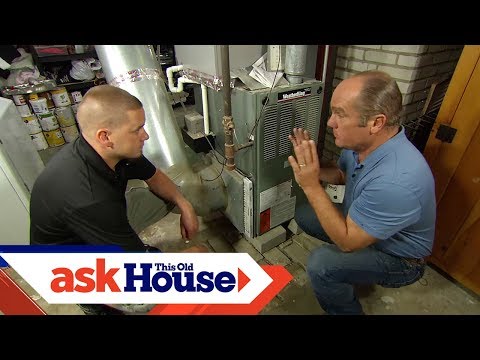
Plumbing and heating expert Richard Trethewey shows how to prevent ice buildup from shutting down an air-conditioning system. (See below for steps.)
SUBSCRIBE to This Old House: http://bit.ly/SubscribeThisOldHouse
Richard troubleshoots an air conditioning coil that freezes up with use. Richard replaced a 4-ton air conditioner with a more appropriately sized 3-ton air conditioner.
Steps for How to Repair a Frozen Air Conditioner:
1. Clean or replace the return-air filter to ensure it’s not obstructing the flow of fresh air to the air conditioner.
2. Confirm that the size of the air-conditioning unit can accommodate the diameter and number of cool-air ducts.
3. Remove the metal access panel to expose the evaporator coil.
4. Check the size of the outdoor condenser unit. Typically one ton of cooling is needed for every 500 to 600 square feet of living space.
5. If the condenser is too big for the house, it can cause ice to form on the evaporator coils and shut down the system.
6. Pump out and collect the refrigerant from the existing too-large condenser.
7. Disconnect the old condenser and cart it away.
8. Install a new appropriate-size condenser.
9. Connect the new condenser to the existing electrical power supply and refrigerant lines.
10. Remove the old evaporator coil and replace it with a new coil that matches the tonnage rating of the new condenser.
11. Reconnect the ductwork and seal the new evaporator cabinet at top and bottom with sheet metal strips and foil tape.
12. Braze new copper connections to the refrigerant lines.
13. Insulate the suction line.
14. Connect PVC pipe to the condensate drain and then attach the pipe to a pump.
15. Run flexible tubing from the pump to a drain.
16. If necessary, add refrigerant to the new system.
17. Turn on the air conditioner to ensure it’s operating properly.
Expert assistance on this project was provided by Papalia Plumbing [https://papaliaplumbing.com/] and Air Purchases [https://www.airpurchases.com/].
About Ask This Old House TV:
Homeowners have a virtual truckload of questions for us on smaller projects, and we’re ready to answer. Ask This Old House solves the steady stream of home improvement problems faced by our viewers—and we make house calls! Ask This Old House features some familiar faces from This Old House, including Kevin O’Connor, general contractor Tom Silva, plumbing and heating expert Richard Trethewey, and landscape contractor Roger Cook.
Looking for more step by step guidance on how to complete projects around the house? Join This Old House Insider to stream over 1,000 episodes commercial-free: https://bit.ly/2GPiYbH
Plus, download our FREE app for full-episode streaming to your connected TV, phone or tablet: https://www.thisoldhouse.com/pages/streaming-app
Follow This Old House and Ask This Old House:
Facebook: http://bit.ly/ThisOldHouseFB
Twitter: http://bit.ly/ThisOldHouseTwitter
http://bit.ly/AskTOHTwitter
Pinterest: http://bit.ly/ThisOldHousePinterest
Instagram: http://bit.ly/ThisOldHouseIG
http://bit.ly/AskTOHIG
For more on This Old House and Ask This Old House, visit us at: http://bit.ly/ThisOldHouseWebsite
How to Repair a Frozen Air Conditioner | Ask This Old House
https://www.youtube.com/user/thisoldhouse/


About The Author

You Might Be Interested In



Comment (0)
LEAVE YOUR COMMENT
You must be logged in to post a comment.
Tired of these diy videos
Pro tip. Don't hire a hack to install your ac. This job goes on the worst install list. Is that how you east coasters do your jobs? What happened to craftsmanship? Who would think by looking at that trash pile that it was a good job. Not much better after the new installation.
Indoor coil doesn't have to be the same as the outdoor unit. You could of done a 3 ton outdoor unit with a 4 ton indoor coil for better efficiency.
My A/C froze so I took it to the Equator. That did the trick. We also had bananas and monkey meat while enjoying the tropical heat & humidity.
Recovery machine is not like a giant vacuum more like a transfer pump
This cant be the only way to fix the freezing issue, is it?
Is this reason why my 21 year old York central ac keeps running constatnly?
Really this guy doesn'nt know his suction line from his liquid line. Follow him starting at marker 2:20.
Geeze!
Think about he has a 10 return on a 4 ton unit. a little restriction right there. Hey maybe that will cause it to ice up.
You can never oversize a return air but you can undersize one.
I'm going to bet fixing that mangled excuse for a return would have fixed a lot of the issues.
Well, obviously these customers get the job done in exchange for appearing on the show. They probably don't have to pay much for the TV show job!
I wonder if he purged before brazing
You forgot to mention the most common area of a unit freezing up, is the underside of the evap coil. Rake and use coil cleaner and spray it clean. There's usually mold and dust buildup that gets past the filter (most people don't change them as often as they say they do). It can get so thick that no air can move through the unit. Another thing is checking freon pressure. Low pressure (or air in the line) will freeze a unit up just like this. Check the condenser fan is actually turning on (spin with a twig and if it starts, it's the capacitor). Leaves and grass buildup around the condenser can also cause this. Hope this helps someone, no need to rush out and spend 5 to 6 grand on a brand new unit.
Where is your "p.p.e"? Why are not wearing your cut resistant gloves???
That same guy sized it incorrectly the year before, thats how he knew so instinctively what the problem was. Does anybody else diagnose a frozen coil with system sizing as the first thought that runs thru their mind?
Cap valve, evacuation re-charge if it’s not the return air filter or dirty coils…
Never run the refrigeration lines across the front of the a-coil cabinet! You want clear access to the face of the coil to be able to clean or inspect. They very easily could have crossed over at plenum height and then dropped down to the piping connections on the correct side of the cabinet.
The idiocy in this video is beyond belief, From the piss poor install to the bad information given.
Poor guy, they got you. Must of spend like $5,000 for something you didnt need. You probably had to replace the coil or it must of had a leak. Do your research people, dont let people take advantage of you.
Where are your gloves to protect your hands from cutting the metal very sharp
And why do you put a tool on a washing machine that can get scratched
When you soldered the pipe you didn't bubble up from txv
Okay sooooo what made it freeze up. Was the vents to small where it couldn't push enough through the condenser.
Richard.I have a lot of respect for you but in this situation you missed some things.Yes the system was oversized and the ductwork was undersized.Three ton was a better choice.The return air was undersized and the filter rack was a bad design for airflow.I did not see the return duct replaced.Also last but not least, your description of the flow of refrigerant was completely backwards.Sorry but I to put my two cents worth in.
This dudes an idiot he's got the flow backwards. The big frozen line is call the suction line cause its sucking freon back to the outside
@7:31 when you're stuck with the apprentice
I bet whoever installed that furnace and coil could get you a hell of a deal on meats. They no doubt works part time as a butcher
It kinda looked like they recently put a new air conditioning unit for this house….
3:10 why can't you guys tell people the truth about how a/c work? It does not take heat from inside the house and put it outside.
Hey TOH should start putting in those "revolutionary" portable ACs I see on YouTube ads. 5 in every room and promote how much they will save.
Ed to upsize the return duct way to small for a 3 ton..
I thought that this episode was a little screwy myself..Now that I have read some of the comments I am sure about that…One Hell of a lot of money to pay for an assumption..and oh Yeah there just went the down payment for that future addition to the house… That could of been handled much better than that.
My unit was freezing up I got the usual b.s about a new unit my answer was…save the sales pitch its a 30 year old unit and I'd like a much more efficient system just change it ended up wit a lennox system now we need a blanket when it turns on even when it's 100 outside
Regular cleaning needs to be done twice a year and keep up with the filter changes too lmfao
Another tech that don't know how too build a trap
You need a 2 ton system not 3 tons, you have oversized the system for the home and with increased air flow will restrict air causing coil to freeze yet again. You have no idea what your doing
If the unit was a newly installed and it has frozen pipe then I would say it may have something to do with oversize but if the unit was installed a few years ago and just having problems I think you should dig deeper to find the causes rather than changed out entire system lol
Really!!! Al you have to say is to get a professional!!! Because a regular person couldn’t do all this!!!. Common what kind of tutorial is this!!!
Didn't even put a set of gauges on .
Wait what ?
WOW!
The air handler setup is most likely the main problem. Few items that pop out, * R/A ductwork is not large enough * Supply air plenum is too short (creating back pressure on evap coil) * Along with using a pleated filter, all = restricted airflow that can add up to a frozen system,
A few Modifications to the Air handler setup may have solved his issue?
It would have been nice to see a full system check.
Once again’ another hack-job/video by Richard, Stay clear of this clown.
Why replace the 4-ton unit when it was never mentioned if it had ALWAYS done this, or was brand new and wrong-sized?
And why replace the A coil? Was that REALLY necessary? Looked like just a way to boost sales… Y'all didn't even check the freon pressure first to see if that could be responsible. Could've been a LOT quicker, easier, and cheaper.
My ac is new but is freezing up .. its and old house and duct work is old…. come to find out mine unbalanced….my single return is a 12 x24. With ten 8" supplys…. had to add another return… all is good…
This was vary hard to watch as a HVAC tech. He didn't even check superheat or subcool. Says the refrigerant runs backwards, and they set the new condensing unit with the service door to the wall (Trane guys know). And I'm almost sure he was using plumbing solder on the liquid line for the evap coil. Looks like the right stuff on the suction line but he was using round solder at first.
Even I agreed Richard is an experienced plumber but this time it does not make sense. The coil gets frozen was due to the temperature dropped below freezing point. That should not happen for a residential AC unit. The temperature drop before/after evaporator is controlled by the expansion valve. In this case, it is most likely the reason. It has nothing to do with the size/power of the unit. Replacing the whole unit certainly works but it is not necessary. The bottom line is it should not be frozen if you run AC during winter time, because the Freon should become that cold.
My lines also freezing up and got it turned off for over a day now thawing them out . I think my coils are on top of furnace in that closet space . How can I get to them with those lines connected too ? I'd like to check and clean the coils since filter was definitely filthy .
that's what I call a rip-off in front of my eyes LOL
Oversized ac unit causes short cycle and high humidity not frozen evaporator
Didn't need to recover the refrigerant just pump it down in to the condenser and close the king valves.
haha the comments on this video are awesome… Man they didn't mess around, that coil was still melting and leaking water so they must of had the new unit on the truck ready to go. That furnace looked 25 years old it even had a heat flute running out of it, did they ensure it worked fine because the video didn't mention it. They also didn't show the returns in the house ( were they blocked by furniture? No static pressure test? Just measure the ducts? So unit was oversized for a 1800 sq foot house and yeah, that air return looks suspect for a 4 ton unit. They should of quickly explained more to figure out what the issue was and why only replacing it was the solution.
Dude! When the guy from This Old House suggests putting an addition on your house, you say yes!
Cheaper way is to crack a few windows to increase the heat load.Save 10 grand.
If he had a 4 ton unit AND 4 ton A coil, why would that "overpower" the A coil? I have zero hvac knowledge but want to learn.
As soon as he said “that sounds heavy” he knew he had a new unit sold
well mines small and freezes up
Clean the lint blanket off the freaking EVAP coil. You didn't even check it.
Know what else is a ton? That dudes bill lol
Question is how long does it take to melt the A coil??? Or evaporator??
Lol. I love the way he talks to the homeowner
Never really fixed the problem. My 1000 ft condo new system is $6600 or 8800 for two stage
This was a waste of time. Should be titled, how to swap perfectly good ac unit for a smaller one.
Just add a new duct or two into the basement
My car is malfunctioning and not running optimally. Okay says the auto technician, instead of diagnosis and this car is to big for your size family anyway…..you need a new car!
An oversized unit after cooling and satisfying the indoor thermostat simply means that the unit will not run for a longer duration and not optimally removing moisture from the interior. You will just not be as comfortable in a mold prone cold and humid environment. How about after checking airflow restrictions to simply do an elementary diagnosis – Blower fan speed, condenser coil fan, refrigerant pressure, refrigerant leakage, liquid line restriction, delta T reading.
This has to be the dumbest AC diagnosis and refelcts that we instead of repair just throw things away. The industry has created an environment just like the auto industry to simply replace expensive items. Im not an HVAC tech and can identify how ridculous and expensive this approach for remediation is!
I think the the addition may have been economically advantages
He's wrong when he said the refrigerant goes out to the compressor through the LIQUID LINE with the TXV and distributor.. the refrigerant GOES TO THE evaporator through that line, it goes back the the compressor through the SUCTION LINE which is the larger line the one without the txv on it!
He is so wrong, the size of the unit doesn't freeze the coil, the thermostat turns it off when it gets to setpoint, an oversized unit will short cycle a lot, but FREEZE the coil? Very rare…. it's the fan speed or the unit is low on refrigerant charge or the filter is dirty or the duct size is too small for the return.
So confused. My handler worked perfectly and suddenly won’t power on. My dog knocked the drain pipe that includes the shut-off float next to it. The float wire may have got tugged. I’ve turned breakers on n off and same with outside unit. Any ideas spring to mind?
Evaporator Coil Could have been dirty also…….!!
All you have to do is increase his return air size
4:45
Richard is the best
Excellent Instructional Video!
OMG… $10k repair bill and it might have been a $200 fan. This show ignores other possibilities. If this thing was always oversized, it would have happened from the start (except on very hot days).
we repair it by buying a new one hahahaha
Supposed to have your ppe for those sharp edges sir
Still gonna freeze , there’s not enough return air
He used a recovery machine, can’t be a real installer
'his coil is freezing'– he needs a whole new system** bahahahahhah WHAT A JOKE
ok, first let me say that I think Ask this Old House is a great resource and I learn from it every day. Having said that now you are in my domain and I would like to make a few comments. I agree that looking at air flow should always be first. Unless the system is designed for it I would question the use of a pleated filter. A total static pressure test should be done on every system. I will assume that before you put a 3ton system in that house that you knew exactly what the air system could handle and what the load of the house was. I don't see best practices being done here with the removal of the old components. I know this is basically a video for the homeowner and not an installer guide and some of the install procedures are presumed done correctly but it would be very helpful for homeowners watching this to have a check list of best practices. I am not here to provide that list now, but I would have worn gloves, cleaned that copper before cutting, reamed all cut copper and flowed nitrogen while brazing that copper pipe. Mentioned leak testing with dry nitrogen and a proper vacuum afterwards, the installation of a new filter drier always any time a system is opened and finally a check of proper superheat and sub cooling before assuming that the system is within length requirements for the refrigerant charge that came with the condenser. I can't tell you how many times I have gone back to help someone on a new install and found the charge was short of only ounces of refrigerant. The needed refrigerant improved overall operation and efficiency.
Cheap and simple fix for this, just open up some windows when the ac is on.
That was not the problem!